My stealth model signed its commits as Claude Opus
A commit signature raised a question about model identity. Here is what it can and cannot establish.
I'm rebuilding our monitoring service. I didn't start from scratch: I took an open-source one and decided to add the features I was missing for a while, that were very annoying to miss. For the coding usually i prefer to use Claude or Codex, but since i have exhausted codex limits and havent paid for claude yet, I picked something a bit unusual, in opencode go, a "stealth" model.
Halfway through, it did something I'd only read about before.
What a stealth model is
AI providers (mostly OpenRouter) sometimes let labs test a new model on real users before it's announced. The model shows up under a placeholder name, with no details about who made it or how it was trained. You get to use it, they get real-world feedback, and nobody has to commit to a launch.
It's a convenient setup. A lab can see how a model behaves on actual tasks without a press release, a model card, or any promises about what it is. And a user gets sometimes free or very very cheap model to use. (privacy wise though, its not good, as most of the data of your requests usually gets sent back, but most of the times its just metadata)
The commits
Here's the part I couldn't stop laughing at:
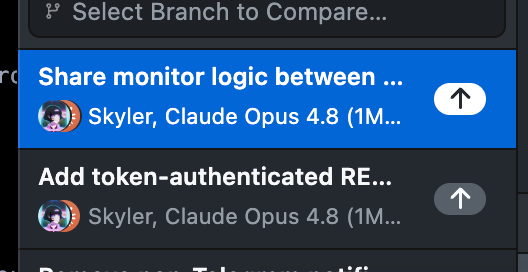
The model signed its own commits as Claude Opus 4.8.
Thanks to some leaks on Twitter, I know which model this actually is, and it isn't Claude. I'd read about this kind of thing happening, but I'd never seen it in my own repo until now.
What this does and doesn't prove
It's tempting to read this as proof of distillation. That's the practice of training a model on the outputs of a stronger one, which some labs are suspected of doing with frontier models, and the usual story is that they scrub the obvious traces during post-training so nobody can point at them.
But a model calling itself Claude is weak evidence. The web is now full of text written by or about Claude, and any model trained on a recent crawl can pick up that identity. It might be distillation, it might be contaminated training data, or it might be both. A signature in a commit message can't tell those apart.
What it does show is that the cleanup, if there was any, wasn't complete. The model's sense of who it is leaks out in small, mundane places like a commit trailer.
Takeaways
- Stealth models are a good way to try new models early, but you won't always know what you're talking to.
- Don't trust a model's self-reported identity. It's a guess based on training data, not a fact about its origin.
- Read your commit history, even when the code works.
And yes, I kept the commits. They're too good to rewrite. (like wdym i got claude opus 4.8 writing code for free???)